
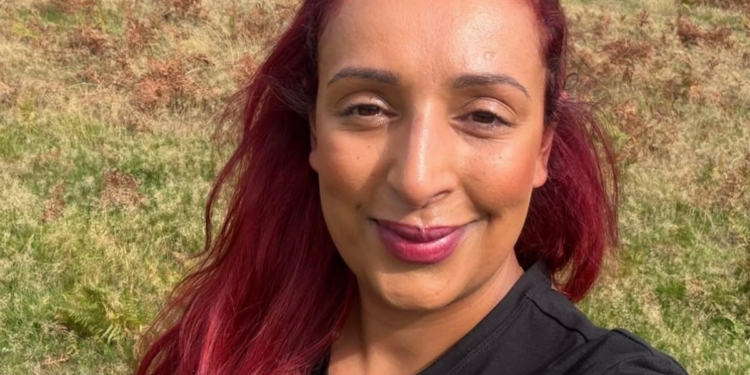
Aunee Bhogaita is Training and Quality Coordinator at Inizio Engage, Patient Representative at Royal College of Psychiatrists, trauma-informed coach and Director of Brown Girl in a Bottle from Leicester, UK.
In an exclusive interview she talks to Rameez Makhdoomi
A bt about your childhood days ?
A lot of my childhood is difficult for me to remember because I think I have blocked quite a lot of it out. But the memories I do have are almost a mixture of two very different childhoods happening at the same time.
I come from a South Asian background and grew up with my mum, dad and sister in a semi-detached house, with members of my dad’s extended family living next door. Family was a huge part of life. Back then, extended family wasn’t really “extended” in the way we might think of it today. Everybody was around all the time. I remember our house constantly being full of people, with one gathering or another taking place. It was busy, loud and very family-orientated.
There were lots of happy memories within that. My sister was like my best friend and we spent so much time together playing games. I also loved reading. Books became my solace and, in many ways, my escape from reality.
My parents owned a shop, but they also made sure we travelled. I remember family holidays, visiting India several times and spending some time in Africa. Both of my parents were born in Africa, so being able to see some of the places connected to where my dad had grown up was really special.
But alongside those happy memories, something very different was happening.
Between the ages of five and eight, I was sexually abused by my dad’s youngest brother. He was around 20 when the abuse began and was someone my parents treated almost like a son. More importantly, from the perspective of the five-year-old child I was, he was one of my favourite uncles. I loved and trusted him.
There wasn’t fear attached to him in my mind. I didn’t understand that what was happening was abuse. I thought I was special. We even had a name for what was happening—we called it “tickle”—and at five years old, I didn’t have the understanding to recognise that something was wrong. How does a five-year-old know?
So when I think about my childhood, I don’t think I can describe it simply as either happy or unhappy. Both things existed at once.
There was a little girl surrounded by family, playing with her sister, travelling with her parents and disappearing into books. And there was also a little girl being abused by somebody she loved and trusted, without even understanding that what was happening to her was wrong.
I think that’s why my memories of childhood are so complicated. There was happiness there. There was love there. But there was also something happening beneath all of that which would have an impact on me long after childhood ended.
How was academic journey like ?
My academic journey has been an interesting one because, in many ways, it has spanned nearly 4 decades.
I was always very bright at school, although I don’t think I fully recognised that about myself until much later. As a child, I particularly loved writing stories. I’ve always had a vivid imagination, and I would spend ages writing. Sometimes my teachers would ask me to read my stories aloud to the class, and I remember really enjoying that.
When I reached secondary school, I still loved English, but science became my thing. I was fascinated by it and developed a real passion for understanding how and why things worked. Looking back, I think the same curious mind that created all those stories also fed the scientist within me.
College was slightly bumpy at first. I initially chose A-levels such as media and sociology before realising they simply weren’t me. Science was where my heart was, so I changed direction and eventually went on to study Biomedical Science at Nottingham Trent University.
I particularly loved human pathology. I was fascinated by disease and what was happening within the human body—the biochemistry, physiology and pathophysiology behind it all.
But life had other plans for my academic journey.
I became pregnant with my daughter during my first year at university. After having her, I returned to university for my second year with a baby who wasn’t even a year old. I passed that year and progressed into my third, but at the same time I was navigating a very toxic relationship with the father of my children. Trying to manage full-time university, being a full-time mum and coping with an emotionally abusive and unstable relationship eventually became too much. In March of my third year, I left university.
At the time, I genuinely never thought I would go back.
Years later, something unexpected happened while I was in rehab. As part of my treatment, I had to do a lot of written therapeutic work and assignments, and I rediscovered that love of writing and learning. Recovery was also reconnecting me with myself. For a long time, I had believed that I wasn’t intelligent, that I wasn’t capable and that I wasn’t worthy.
Slowly, I started thinking, Actually, I am intelligent. I am worthy. Maybe I can do this.
While I was still in rehab, they ordered a university prospectus for me. Eight weeks after leaving rehab, I went back to university.
I repeated my second year of Biomedical Science, completed my third year and graduated with First-Class Honours.
And then I thought, I’m not quite finished yet.
I went on to complete a Master’s degree in Molecular Genetics and graduated with a Distinction.
Academia has remained an important part of my life. I continue to be involved with universities including King’s College London and Queen Mary University of London, particularly through research projects and studies, and I remain connected to the wider research and academic community.
So my academic journey certainly wasn’t conventional. There was a very long gap between the young woman who walked away from university believing she would never return and the woman who eventually graduated.
But I got there in the end—and I got there with a First-Class Honours degree, a Master’s with Distinction, and, I’d like to think, a little bit of style.
More importantly, education became about much more than gaining qualifications. Going back to university was part of reclaiming the person I had once believed I wasn’t: intelligent, capable and worthy.
What helped you to rise from victim of abuse to icon inspiring humanity ?
I think this is a really interesting question because, in some ways, I will always have been a victim of abuse. I was sexually abused, and I was a victim of that. I experienced domestic abuse, and I was a victim of that too. Recovery doesn’t rewrite those facts, and I don’t need it to.
What has changed is the way I relate to those experiences.
For a long time, I lived within what had happened to me. I thought about it, dwelled on it and carried a lot of pain, anger and resentment. Eventually, addiction became another way of dealing with that pain. I wasn’t just dwelling anymore—I was running from it and numbing it.
And that nearly cost me my life.
It was in rehab that I came to a very simple but profound realisation: no matter what I do, I cannot change my past. I cannot rewrite my story. Even if I died tomorrow, it wouldn’t change the fact that I was sexually abused. It wouldn’t change the domestic abuse. It wouldn’t change my addiction or any of the other trauma I had experienced.
So I had to ask myself: What am I going to do with it?
I’d tried dwelling on it. I’d tried running from it. I’d tried numbing it. None of those things had worked particularly well for me.
So I decided to try something different. I decided to empower myself through my experiences.
I can’t change what happened to me, but I can decide what I do with what happened to me. I can use those experiences as fuel to create something better. I can speak about the things people often don’t want to speak about. I can use my voice to reach somebody who might be experiencing abuse, struggling with addiction or trapped in that same cycle and thinking, Surely I can’t be the only one.
Because you’re not the only one. We’re here. And together we’re stronger and we’re louder.
Therapy has been a huge part of that journey for me. I’m a massive advocate for therapy because it helped me process not only my trauma, but the emotions attached to it. I carried an enormous amount of anger for years, and that anger was destroying me. It was contributing to my own self-destruction and affecting the people I loved, including my children.
Therapy taught me that there was nothing inherently wrong with feeling angry. The important thing was understanding where that anger came from and giving it somewhere safe to exist.
When you give your emotions a voice and actually listen to what they’re trying to tell you, you don’t have to spend your life suppressing them until they explode. You can learn to sit with them, understand them and work with them rather than allowing them to control you.
For years, I thought I was weak. Coming through everything I have experienced has shown me the opposite. You have to possess strength to survive those experiences and continue navigating life. And I think it takes tremendous courage to go back through those experiences in therapy, look at them properly and begin healing from them.
So I don’t think becoming the person I am today has been about escaping the fact that I was once a victim. It’s been about understanding that being a victim of something does not mean I have to remain powerless because of it.
I couldn’t choose what happened to me.
But I could eventually choose what I did with it.
Your current projects?
For me, I still feel as though I’m at the beginning of this journey. Brown Girl in a Bottle CIC was registered last year, so although a lot has already happened, there is still so much that I want to build and achieve.
One of our biggest projects is a documentary called Brown Girl and in a Bottle. The documentary isn’t focused solely on the trauma I’ve experienced. It’s really about the journey from being someone who was unhealed and in active addiction to becoming someone who is healing and living in recovery.
An important part of that story is highlighting the services that helped me along the way.
When subjects such as sexual abuse, domestic abuse and addiction are taboo within your community, it doesn’t just make it difficult to talk about what is happening to you. It can also mean you have very little knowledge of where to go for help. Even in 2026, there is still so much silence, stigma and shame surrounding these subjects, and those things create very real barriers to somebody being able to say, “I need help.”
Sometimes people simply don’t know that support exists.
That’s something I really want the documentary to address. I want people who are going through these experiences—or who are living with the impact of something that happened to them previously—to see that there are organisations and services out there that can help. So one of my major goals at the moment is getting Brown Girl and in a Bottle completed and out into the world.
Alongside that, I’m doing more and more public speaking and lived-experience work. I’ve spoken within NHS settings, I’ve worked with the Society for the Study of Addiction, I have an upcoming event with Thames Valley Police, and I’ve appeared on a number of podcasts where I’ve been able to have conversations about addiction, trauma, recovery and the experiences of people from communities where these subjects aren’t always openly discussed.
I’m also involved in research as a peer researcher, and I’m particularly interested in helping to develop culturally competent training and services.
Ultimately, although these projects might look quite different from one another—documentary-making, speaking, research and training—they are all connected.
They’re about taking lived experience into spaces where it can make a difference. They’re about breaking some of that silence, improving understanding and making sure that people who might currently feel invisible know that support exists and that their voices deserve to be heard.
And for me, this really is just the beginning.
Your future goals especially for humanity as strong leader ?
I wouldn’t necessarily describe myself as a “strong leader”. That’s not really how I see myself. I think of myself more as somebody who has lived through certain experiences, has learned from them and now wants to use that knowledge to help create change.
One area I would really like to become involved in is the justice system. It’s one of the spaces I haven’t worked within yet, but it’s something I feel incredibly strongly about, particularly in relation to sexual violence and abuse.
I’ve experienced the justice and court system firsthand, and I know how difficult that process can be for victims. I would love to be involved in work that looks critically at the system as it currently stands and asks how we can make it more victim-informed.
That includes looking at what happens long before a case ever reaches a courtroom. What are the barriers to reporting? What happens during an investigation? Why do some cases never progress to court? What are the evidential thresholds and processes involved, and what is the experience of the person at the centre of all of this?
I think lived experience needs to be part of those conversations.
Another major goal is continuing to address inequalities in access to support services. We often talk about “hard-to-reach” or “seldom-heard” communities, minority groups and other underserved populations, but I want us to look much more closely at the barriers that prevent people within those communities from accessing help.
Everybody should have the opportunity to access treatment in an environment where they feel safe, understood and supported, with treatment that actually works for them. Services need to be willing to adapt to the demographics they are supposed to serve rather than expecting every person and every community to fit into the same model.
Ultimately, I would also like to become more involved in policy and strategy.
There is incredibly important work happening at grassroots level, and I want to continue being part of that. But I’ve also realised that if we want systemic change, lived experience needs to reach the places where decisions are being made.
I want to sit in those rooms.
I want people with lived experience to be involved in reviewing policies, developing strategies, challenging existing systems and helping shape what comes next. Because ultimately, whatever is written at policy level filters down into the services people encounter in real life.
For me, that’s the future of this work: creating a bridge between lived experience, frontline services, research and the people making decisions at the top.
I don’t necessarily need to be called a leader. I just want to be in a position where my voice—and the voices of people whose experiences are too often missing from those conversations—can genuinely help change things.
What tips you would give to especially women going through struggles ?
This question feels quite personal to me because I’m a woman myself, and I think although the world has changed, some of the expectations placed upon women really haven’t.
Growing up, particularly within a South Asian community, there was a very traditional idea of what a woman’s role should be. You looked after the home, your husband, your children and your family. Of course, those expectations weren’t exclusive to South Asian women—they existed across many cultures and communities.
What wasn’t really part of that conversation was looking after yourself.
And actually, even in 2026, I’m not convinced that’s changed enough. Instead, we’ve almost just added more expectations. Now, alongside looking after the home and family, women are expected to be educated, have successful careers, earn money and contribute financially.
We’ve added more roles without necessarily creating the space for women to recognise themselves as human beings who also need care.
At the same time, I think we’ve lost some of the community that previous generations had. We say it takes a village to raise a child, and once upon a time that village was much more visible. Families and communities were often physically closer and more involved in one another’s lives. Today, many women are trying to fulfil all of these roles while living much more independently and sometimes much more isolated lives.
So one of the biggest things I would say to women is: learn to love yourself too.
We’re taught so much about loving and caring for everybody else, but how many of us are actually taught how to love ourselves?
We can give and give and give until there is virtually nothing left. Self-love and self-care aren’t selfish. You are allowed to be one of the people you take care of.
And please reach out for support when you need it. Needing support isn’t a weakness. Support is a tool. Whether that’s therapy, professional services, friends, family or another form of help, it can give you the space to understand your emotions, process your experiences and reconnect with yourself.
Sometimes we spend so long being somebody’s mother, partner, daughter, employee or carer that we stop asking: Who am I? What do I need? What do I want from my life? What isn’t working for me anymore? What do I want to change?
Give yourself permission to ask those questions.
And when it comes to experiences such as trauma, abuse or addiction—things that still carry enormous stigma and shame—I would say this: never be ashamed simply because life happened to you.
Life is life. Sometimes life is beautiful and sometimes, quite frankly, life is shitty. It can be incredibly challenging.
If you’ve experienced difficult things and you’re still standing, there is something to be recognised in that. But I also don’t think we should expect people to spend the rest of their lives simply being grateful that they survived.
For a long time after trauma, people can remain in survival mode. You’re breathing, functioning and getting through each day, but you’re not necessarily living. You’re existing.
You deserve the opportunity to move beyond that.
The goal isn’t a perfect life where nothing difficult ever happens again. Life will still throw curveballs at you. The difference is learning to understand yourself, knowing when to ask for help and developing the tools to navigate those difficult moments without losing yourself within them.
So if I could give women one message, it would be this:
You have spent enough time surviving. Give yourself permission to discover what it means to actually live.
Your message ?
My message would be that your experiences in life do not define who you are.
Every experience—whether traumatic or not, whether incredibly challenging or simply part of navigating life—can offer us an opportunity to learn something about ourselves and, eventually, an opportunity to grow.
That doesn’t mean finding something positive in what happened to you. There are experiences such as sexual abuse and domestic abuse where the trauma is incredibly deep, particularly when the person who caused that harm was somebody you loved or trusted.
Those experiences can become so deeply ingrained within us that it can take years even to recognise the impact they’ve had. They can shape how we see ourselves, how we form relationships, how we respond to the world and, sometimes, keep us living in a constant state of survival.
But one of the most important things I’ve learned is that nothing I do today can change what has already happened to me.
What I can change is what I do with it now.
For me, that has meant learning to empower myself through my experiences rather than allowing them to continue holding power over me. And I could not have done that without support.
I cannot emphasise the importance of support enough. Support is essential. Whether that’s professional help, therapy, talking to friends or family, or simply having somebody you trust who will listen—reach out.
There is no weakness in asking for help. In fact, I think recognising that you need support and actively seeking it is one of the most responsible things you can do for yourself.
Talking is incredibly powerful. Being heard is powerful. Understanding yourself is powerful.
You cannot rewrite what has already happened, but your past does not have to dictate everything that comes next.
We all deserve more than simply surviving what happened to us.
We deserve the opportunity to heal, to live and, ultimately, to thrive.