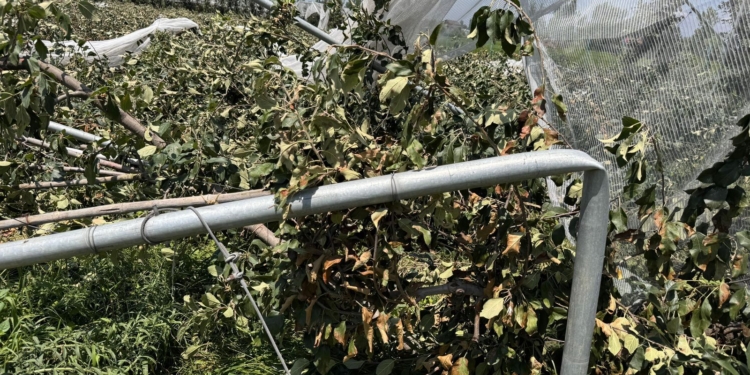
Anantnag, Aug 12: In the heart of Kashmir’s apple country, just days before harvest, a mild gust of wind was all it took to bring down an entire high-density orchard. The collapse of the galvanised iron (GI) trellis system in Mirdanter village, Anantnag, has left grower Arif Shafiq Bhat counting his losses — and the region’s horticulture industry counting the cost of substandard infrastructure.
Bhat’s eight-kanal orchard, planted in 2019 by a private developer, was meant to be a model of Kashmir’s high-density revolution — delivering higher yields, better quality, and greater resilience. Instead, on Thursday morning, he watched in disbelief as the flimsy metal frame buckled, toppling rows of fruit-laden trees. “The trellis was too weak to withstand even moderate weather,” he said. “If proper material and engineering had been used, this wouldn’t have happened. I have lost a season’s worth of work, and it will take years to recover.”
Investigations reveal a pattern that stretches far beyond one farm. Across the valley, orchards are being fitted with GI trellis systems made from thin, under-spec pipes — often less than 1.5 millimetres thick and weighing under 10 kilograms — a far cry from the strength required to support trees for decades. Indian Standard (IS) 1239 mandates that 60-millimetre diameter GI pipes should weigh at least 5.5 kilograms per metre. Only heavy-grade pipes, with a thickness of 4 millimetres or more and a 250 GSM zinc coating, are considered suitable for in-soil use.
But on the ground, experts say the cheaper, lighter Class A pipes dominate. “Anything less C Class heavy-grade GI pipes or reliable prestressed concrete poles is a recipe for disaster,” warned a senior horticulture engineer. “Orchards are built for 40–50 years, but these structures sometimes fail in under five. The result is massive farmer losses and damage to the credibility of high-density cultivation in Kashmir.”
Adding to the problem is poor or absent structural engineering in trellis system design. Experts stress that the layout, anchoring, and tensioning of trellis systems require precise calculations to withstand wind and snow loads over decades. However, many orchards are being installed without following such structural guidance, dramatically increasing the risk of failure.
Hailnet, installed to protect crops from hail, has also emerged as a weak point. In many cases, third-party contractors are putting up nets without proper design considerations, especially the placement of cross wires and the specification of the nets themselves. Poor-quality or improperly tensioned nets can catch the wind like sails, placing enormous stress on already underbuilt trellis frames. Without maintaining airflow and structural integrity, even a moderate storm can lead to catastrophic collapse.
Industry insiders say farmer awareness is a crucial missing link. Many growers are unfamiliar with the technical standards required for long-term orchard stability and rely entirely on contractors, some of whom cut costs by using lighter materials or skipping key structural components. “Farmers need to be informed about the right specifications, the importance of engineering design, and the dangers of compromising on quality,” the horticulture engineer added.
The stakes are enormous. High-density apple cultivation has been promoted as the future of the valley’s fruit industry, drawing in thousands of growers with the promise of better returns. Yet without strict regulation, proper design, and enforcement of quality standards, the infrastructure meant to hold up this promise may itself be the weakest link.
For Bhat, the damage is already done. His trellis lies twisted on the ground, his apples bruised and unsellable. “This is not just my loss,” he said quietly, surveying the wreckage. “If this continues, it will be the loss of our entire apple industry.”