

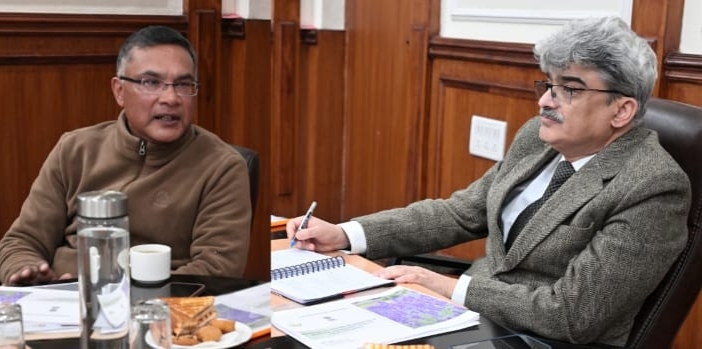
JAMMU, DECEMBER 06: Chief Secretary, Atal Dulloo today chaired a joint meeting of the Forest and Agriculture Production Departments along with the CSIR–Indian Institute of Integrative Medicine (IIIM), Jammu, to evolve a comprehensive roadmap for commercial cultivation, conservation and large-scale promotion of medicinal and aromatic plants (MAPs) across Jammu and Kashmir.
The meeting was attended by the Additional Chief Secretary, Agriculture Production Department; Commissioner Secretary, Forest Department; Director, CSIR-IIIM Jammu; senior officers of the Forest Department, SKUAST, and other concerned stakeholders.
During the deliberations, the Chief Secretary observed that Jammu and Kashmir is currently generating barely ₹12 Cr annually from the MAP sector, which is significantly low compared to its immense potential estimated at nearly ₹10,000 Cr at the national level and about ₹2 lakh Cr globally. He emphasized the urgent need for a structured, scientifically driven and commercially viable strategy to unlock the sector’s economic and livelihood potential, particularly for enhancing farmers’ incomes.
Stressing inter-departmental coordination, the Chief Secretary directed the three key stakeholders of Forest Department, Agriculture Production Department, and agricultural research institutions to work with clearly defined roles and responsibilities. He underlined that the Forest Department must focus on propagation of planting material in natural habitats through its nursery network, provide hands-on training to farmers, and develop replicable cultivation models.
The Agriculture Production Department was asked to identify the most commercially viable species from among over 1,100 MAP species found in the region. The department was also directed to undertake agro-climatic zonation for species-specific cultivation, develop scientifically validated packages of practices, strengthen extension services, and focus on value addition and market integration.
CSIR-IIIM Jammu and SKUAST were advised to provide technical expertise, facilitate technology transfer, and support knowledge dissemination for MAP cultivation. The research institutions were further encouraged to establish Centres of Excellence in Medicinal and Aromatic Plants and develop scientifically robust germplasm banks for preservation and research.
The Additional Chief Secretary, Agriculture Production Department, Shailendra Kumar, emphasized that the roadmap should be long-term and sustainability-oriented. He said the focus should be on creating a self-sustaining ecosystem that ensures attractive returns for farmers, with government support limited to initial handholding through inputs, capacity building and assured market linkages.
Commissioner Secretary, Forest Department, Sheetal Nanda assured full departmental support and highlighted efforts to make regulations more farmer-friendly. She informed that Forest Department nurseries would serve as key support hubs by supplying quality planting material and providing skill training to ensure successful implementation of the initiative.
Managing Director, HADP, Sandeep Kumar briefed the meeting on initiatives already undertaken under the Holistic Agriculture Development Programme (HADP). He informed that 28 MAP clusters involving nearly 1,400 farmers have been established, with cultivation of species such as Lavender, Harad, Wild Marigold and Rosemary. He added that over 5,300 farmers have been trained during the past two years through field demonstrations, skill development programmes and marketing interventions. The meeting was also apprised about high-demand MAP species suitable for J&K, with market prices ranging from ₹100 to ₹1,00,000 per kg.
Director, CSIR-IIIM Jammu, Dr. Zabeer Ahmad highlighted the phytopharmaceutical and nutraceutical potential of medicinal plants found in J&K and outlined IIIM’s role in translating research leads into market-oriented products. He also briefed the meeting on various CSIR Missions in bio-resources, medicinal and aromatic plants, floriculture, and smart agriculture aimed at improving soil and plant health. He informed that IIIM has developed and commercially released several MAP varieties and maintains extensive germplasm banks.
Dr. Ahmad further stated that CSIR-IIIM envisions positioning Jammu and Kashmir as India’s leading hub for a MAP-driven bio-economy, focusing on high-value cultivation, processing and export promotion. Being a recognised biodiversity hotspot, J&K hosts more than 1,100 native MAP species, including around 25 high-value crops with strong global demand. With the global MAP market projected to exceed USD 650 billion by 2030 and India currently holding less than 10 per cent share, the region holds vast untapped potential.
The proposed transformation strategy includes land zonation and optimisation using degraded forest patches, fire lines and marginal government land; establishment of aroma and phyto-pharma clusters across Jammu, Kashmir and the Chenab Valley; and fostering strong community-institution-industry partnerships.
The meeting also discussed the need for suitable amendments to the J&K Minor Forest Produce Policy-2022 to encourage farmer participation, facilitate species identification and niche area development, strengthen R&D infrastructure, and improve market linkages across the Union Territory.

Chief Secy leads inter-departmental drive to unlock MAP sector potential in J&K
ADVERTISEMENT
ADVERTISEMENT
ADVERTISEMENT

Leave a Reply

Kashmir Media Watch (launched on 12 March, 2010), a pioneer among news portals in J&K, owes its origin to the idea that an unbiased, impartial and objective reporting on Kashmir is posted out to readers worldwide who want to remain updated on what is happening in Kashmir.
Contact us: kashmirmediawatch2010@gmail.com