

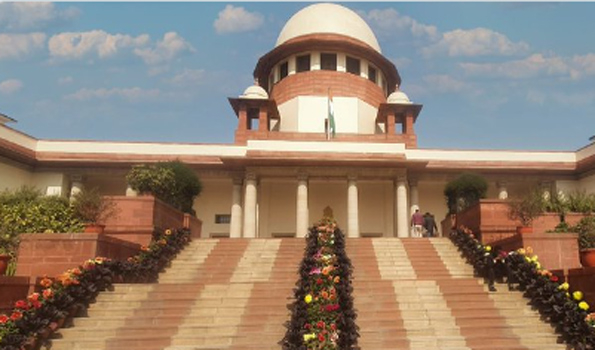
New Delhi, June 9 Supreme Court on Friday refused to list the matter for urgent hearing on the petition filed by lawyer, Ashwini Kumar Upadhyay during the summer break in connection with his plea to exchange of Rs 2000 currency notes without identification slips.
The Top Indian Court asked the petitioner, Upadhyay, to mention the plea before the Chief Justice Court (CJI ) when the court reopens after summer vacation, after July 2.
“A coordinate bench had already directed for mentioning it before the CJI after summer vacations. Sorry, we cannot list ot for hearing,” the two-judge vacation bench of the Apex Indian Court, headed by Justice Aniruddha Bose and also comprising Justice Rajesh Bindal said.
Upadhyay has filed an appeal in the Supreme Court against the Delhi High Court’s order that affirmed RBI’s decision on an exchange of Rs 2,000 currency notes.
The lawyer, Upadhyay, had filed the appeal in the Top Court challenging RBI’s decision permitting citizens to exchange Rs 2000 banknotes, which are being pulled out of circulation, without any requisition slip and ID proof.
The lawyer, also a leader of the ruling Bharatiya Janata Party (BJP), said that there was a press conference. The Reserve Bank of India (RBI) Governor said that Rs 1.8 lakh crore notes were exchanged, but there was no answer on how much went into accounts.
“In 10 days, 1.8 lakh crores were exchanged. All black money will become white money,” Upadhyay said and pleaded for an urgent hearing into the matter.
The Apex Court observed that everyone pays tax, GST etc. This is a court, not a public platform. The matter has to end somewhere and refused to list it for urgent hearing.
Upadhyay had initially filed the PIL in the Delhi HC challenging RBI’s notification of May 19 and SBI’s of May 20, allowing an exchange of Rs 2000 currency notes without any identity slips. But he did not get any relief from it.
Upadhyay had challenged the notification from RBI and SBI that Rs 2,000 currency notes can be exchanged without identity proof.
“All the black money by drug mafias, smugglers, murderers is being exchange, no requisition slip etc needed, Rs 50,000 crore has been exchanged in 3 days. This is happening first time in the world,” Upadhyay had told the Supreme Court.
Delhi High Court in its order on May 29, had dismissed the PIL filed by advocate, Upadhyay, challenging RBI’s notification of May 19 and SBI’s of May 20, allowing an exchange of Rs 2000 currency notes without any identity slips.
The Delhi High Court did not find any merit in Upadhyay’s petition and thereby it dismissed it.
The Delhi High Court bench led by Chief Justice Satish Chandra, who had reserved its order last week on May 23 after hearing from Upadhyay and RBI, pronounced the order on May 29 on Upadhyay’s plea.
Appearing in person, lawyer Upadhyay filed the plea and claimed before the Delhi High Court that the notifications issued by the RBI and SBI in this regard are arbitrary, irrational and offend Article 14 of the Constitution of India.
Appearing for RBI, senior advocate, Parag Tripathi, had told the bench of the Delhi High Court to dismiss the plea on the ground that the constitution bench of the SC has time and again reiterated that they cannot interfere in the nation’s economic policies.
Tripathi further argued before the Delhi High Court that withdrawing Rs 2,000 notes is not demonetisation but a statutory exercise, hence it is not a public issue.

SC refuses to list case for urgent hearing on exchange of Rs 2000 currency notes
ADVERTISEMENT
ADVERTISEMENT
ADVERTISEMENT

Leave a Reply

Kashmir Media Watch (launched on 12 March, 2010), a pioneer among news portals in J&K, owes its origin to the idea that an unbiased, impartial and objective reporting on Kashmir is posted out to readers worldwide who want to remain updated on what is happening in Kashmir.
Contact us: kashmirmediawatch2010@gmail.com