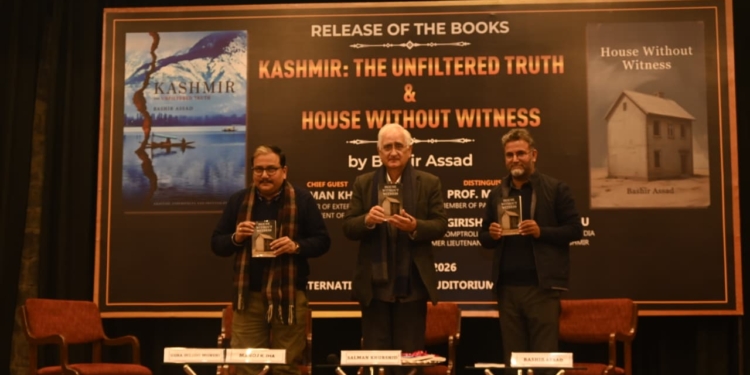
Senior Congress leader Salman Khurshid on Monday said the Supreme Court missed a crucial opportunity to examine federalism in its extreme form while adjudicating the Article 370 case, after accepting the Union government’s assurance on the restoration of Jammu and Kashmir’s full statehood. He was speaking at the launch of two books by journalist-writer Bashir Assad , Kashmir: The Unfiltered Truth and House Without Witness , held at the C D Deshmukh Auditorium, India Internation Center, New Delhi.
Khurshid observed that while the constitution foregrounds fraternity, equality and liberty, federalism has not always received due emphasis in judicial interpretations. The Article 370 proceedings, he said, presented a rare test case to examine federalism at its most intense, a moment that, in his view, the Court chose not to fully engage with.
Rajya Sabha MP Manoj K. Jha, another speaker at the event, praised the books for their unfiltered thought and stressed the urgent need to genuinely listen to the people of Kashmir rather than merely speaking at them. He cautioned against romanticising Kashmir as a territory while overlooking the lived realities of Kashmiris themselves. Reflecting on the narratives of pain and endurance, he said discomfort with agony should not blind the nation to the hope that continues to persist among the people.
Author Bashir Assad, presenting the central idea of Kashmir: The Unfiltered Truth, used a powerful Kashmiri fairytale as a metaphor to explain how identities and inheritances can be eroded not only by external force but also by internal division, rivalry and failure to act together. He underlined that the book does not seek to reopen settled historical choices but instead questions whether legitimate stakeholders can act in unity to reclaim trust, responsibility and a shared future.
The event was attended by diplomats from several countries, including Russia, Singapore, Sri Lanka, Norway, Australia, Angola, Armenia and Bangladesh, reflecting the international interest in informed and nuanced conversations on Kashmir.
The book launch marked an effort to foreground dialogue, reflection and accountability while urging readers and policymakers alike to confront uncomfortable truths with intellectual honesty and collective responsibility.