Ajaz Ahmad War
A year after designating J&K as a union territory carving Ladakh out of the erstwhile state as another territory after abrogation of Articles 370 and 35-A, government has now notified fresh rules that will enable any Indian citizen to buy and in the disputed territory.
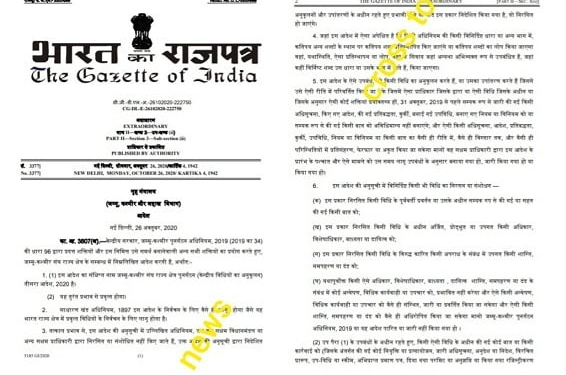
Seen as another step towards the Hindutva backed demographic engineering, the Reorganization Act, as it is known as, was issued on October 26 to pave way for any Indian to be able to buy land and other immovable property in Jammu & Kashmir.
The Reorganization Act annuls 12 state laws and amends 14 in continuation of the abrogation of the special status of J&K and its downgradation into two union territories.
The ministry of home affairs has amended sections of the J&K Land Revenue Act, 1996 and the J&K Development Act of 1970 which respectively deal with the management of agricultural land and the zonal development plans determining land use for public buildings, roads, housing recreation, industry, business, markets, schools, hospitals and public and private open spaces. According to the amendment, any Indian can now buy land in J&K, including agricultural land. Though the amendments prohibit sale, transfer, mortgage and conversion of agricultural land to a non-agriculturist in J&k, MHA has smoothly found a way out while keeping itself the opportunity of a denial available if confronted with allegations of a potential demographic change orchestrated by New Delhi. The order says that agricultural land can be sold to a non-agriculturist if the Government or an officer authorized by it in this behalf may grant permission to an agriculturist to alienate the land to a non-agriculturist by way of sale, gift, exchange or mortgage.
The government can also allow the transfer of agricultural land to a public trust for charitable work, healthcare, education, industrial or commercial purposes. A Board of Revenue headed by a Financial Commissioner has been constituted and a fresh clause defining “agricultural land” as land which is used or is capable of being used for agriculture and allied activities, including fallow land, has been inserted. The amendment omits the permanent resident provision in the 1970 Act that provided housing sites within the range of 25-30 square metres to permanent residents belonging to economically weaker sections of the society and low income groups. The amended gives eligibility to economically deprived people from any part of India for such housing sites.
A new provision authorizes an Army Corps Commander of the rank of Lt. General to declare an area as strategically important for direct operational and training requirements of the armed forces. A written order from a Corps Commander can authorizes Army to take control of the “strategic area” through a sale or lease deed.
The new law createsthe Jammu and Kashmir Industrial Development Corporation for establishing commercial centres and industries in the UT. The Corporation shall consist of twelve directors, four of whom could be nominated from the private sector with experience in industry or trade or finance. The Corporation will have the power to acquire movable and immovable property, and to lease, sell, exchange or transfer any property held by it. If the Corporation is unable to acquire land by an agreement, the government could order proceedings under the Right to Fair Compensation and Transparency in Land Acquisition Rehabilitation and Resettlement Act, 2013 and acquire the land for “public purpose”. No court can take cognisance relating to property vested in the Corporation, unless the files a complaint. No legal suit can be filed against officials of the Corporation without a prior notice of two months and not later than six months from the date of complaint.
The Jammu and Kashmir Land Grants Act, 1960, which regulates grant of government land on lease and earlier applied to urban areas of Jammu, Srinagar and towns, will now be extended to the entire UT. The amendment drops the permanent resident clause to get government land on lease for residential purposes. The J&K Agrarian Reforms Act, 1976, which provided for transfer of land from big land owners to tillers, has been amended. The erstwhile agrarian reforms Act stated that only up to two kanals of land could be held per family for residential purposes.