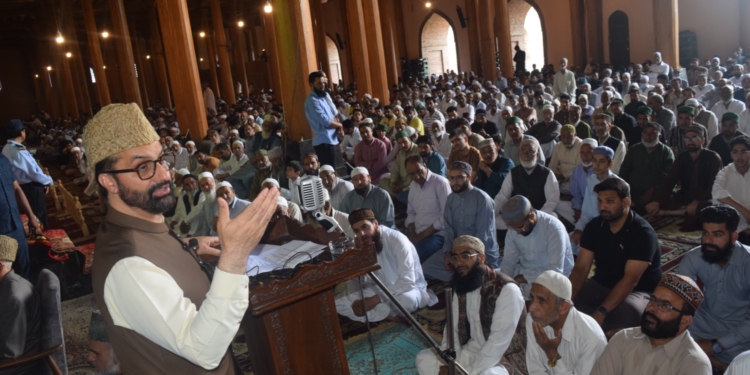
Srinagar, June 26, 2026: Mirwaiz-e-Kashmir Molvi Mohammad Umar Farooq, while speaking at the Friday congregation at Jama Masjid Srinagar on Youm-e-Ashoora, said that the tragedy of Karbala is not merely a chapter of history, but an eternal lesson in truth, patience, justice and sacrifice.
Mirwaiz said Imam Hussain (RA) was not in search of war or confrontation. He stood for the principle that differences must be addressed through truth, adherence to the principles of Islam and sincerity through conversation. But when those before him chose the path of oppression and violence instead, history recorded their failure forever. Imam Hussain (RA) and his devoted companions, on the other hand, became everlasting symbols of courage, sacrifice and steadfastness upon truth. Karbala reminds us that power may appear strong for a time, but in the end it is truth, justice and moral courage that prevail.
Mirwaiz said this lesson is not confined to one time or one place. It speaks to every age, every society and every conflict. When arrogance takes the place of reason, when force is preferred over understanding, and when communication is rejected in favour of confrontation, the result is always suffering and loss. But when truth, patience and discourse are upheld, even in the most difficult circumstances, they leave behind a legacy that history honours.
Referring to recent global developments, Mirwaiz said the recent United States-Israel confrontation with Iran again reminds us that military force, however overwhelming, has its limits. Wars can alter circumstances and inflict immense suffering, but durable peace and lasting solutions ultimately require dialogue, negotiation and statesmanship.
He said even after months of confrontation, enormous expenditure of resources and immense human suffering, adversaries eventually returned to the negotiating table. It is not a sign of weakness on either side; it reflects the reality that disputes cannot be resolved through force alone. Efforts by regional and international actors, including Pakistan and Qatar, to facilitate an environment conducive to dialogue are also worthy of appreciation.
Mirwaiz said this lesson is especially relevant for South Asia, particularly India and Pakistan. Our region is home to nearly one-fourth of humanity. It possesses immense civilizational wealth, extraordinary human resources and enormous economic potential. Yet for decades, political tensions, mistrust and unresolved issues have prevented the peoples of this region from fully realizing these possibilities. Societies suffer not only economically, but also emotionally and psychologically.
Referring to his own commitment to this principle, Mirwaiz said that following the tragic assassination of his father, Shaheed Mirwaiz Molvi Farooq, in 1990, he inherited not only the position and responsibility of the Mirwaiz, but also the obligation to uphold the principles for which he laid down his life. He said Shaheed Mirwaiz was a strong advocate of justice and dialogue over violence and confrontation. He consistently advocated engagement between India and Pakistan and believed that the interests of the people of Jammu and Kashmir and the region would be best served in an atmosphere of peace, mutual respect and meaningful dialogue.
Mirwaiz said whether through the Awami Action Committee that he inherited from him, or later through the All Parties Hurriyat Conference, he has consistently, for more than 36 years, upheld this principle despite facing odds and pushback. Sustainable peace cannot emerge from wars, force or violence. Lasting solutions require engagement, understanding and the courage to listen even to those with whom one disagrees.
Mirwaiz said Prime Minister Narendra Modi is today among the longest-serving leaders in independent India. When he assumed office, he spoke of regional cooperation and demonstrated an interest in improving relations with neighbouring countries. Those gestures generated hope across South Asia.
He said he had the opportunity, along with his colleagues, to engage with leaders across political dispensations, including Prime Minister Vajpayee, Deputy Prime Minister L.K. Advani and Prime Minister Dr Manmohan Singh. While differences remained, those engagements reflected an important principle: dialogue itself has value. It reduces mistrust, humanises opposing perspectives and creates possibilities that otherwise remain closed.
Mirwaiz said it is our hope that the spirit of engagement that informed PM Modi earlier, and the efforts under leaders such as Atal Bihari Vajpayee and Dr Manmohan Singh, once again finds expression.
“Peace may be difficult. Dialogue may be slow. Diplomacy may demand patience. Yet these remain the most reliable instruments for resolving issues and securing a better future,” Mirwaiz concluded.